



Video Editing in Montreal: Post-Production of a Production Company
July 6, 2026The importance of content and storytelling in your video
July 6, 2026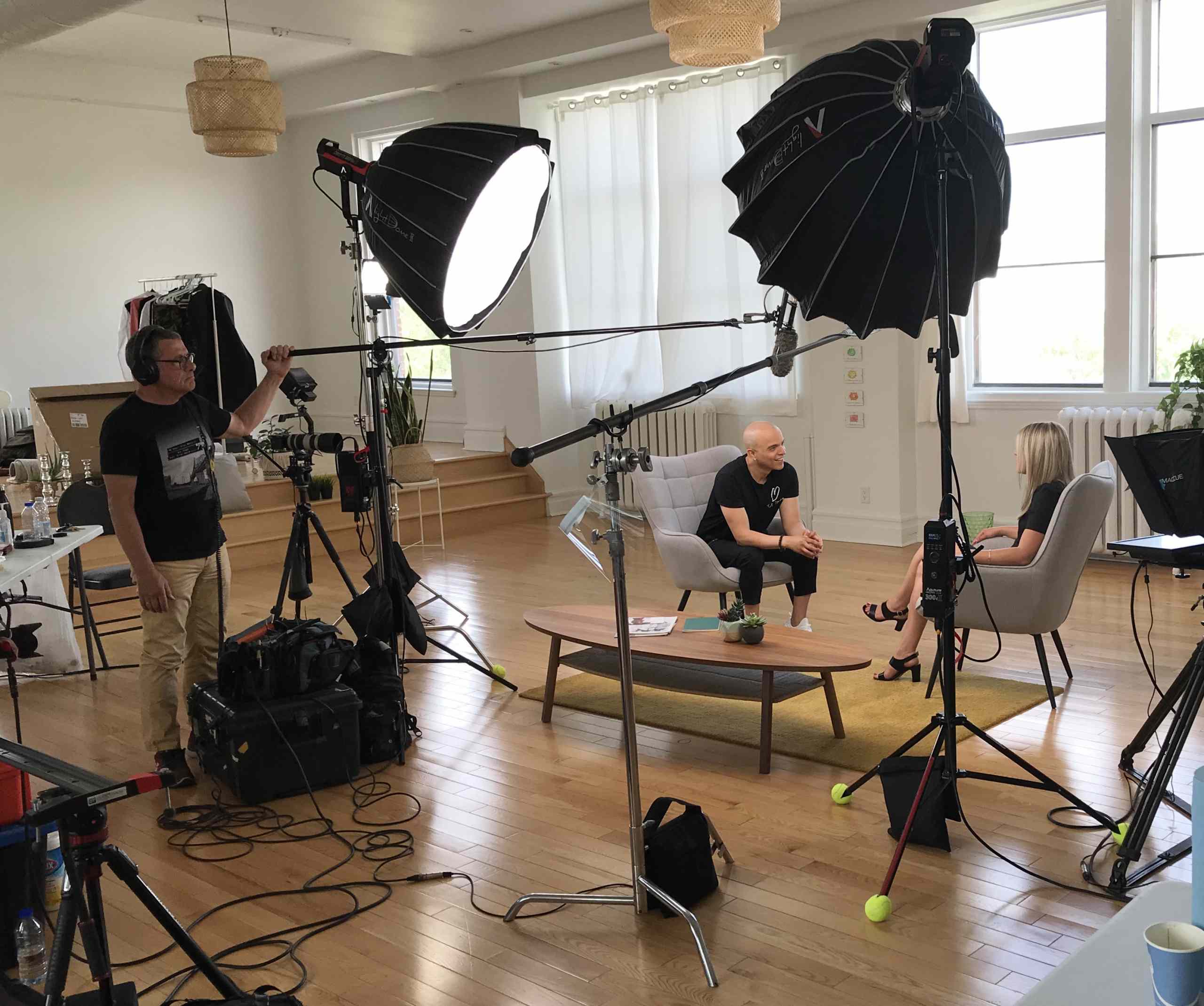
The term corporate video has become a catch-all over the years. An advertisement, a testimonial, a training video, a message from the CEO — everything is called a “corporate video” without distinction. However, choosing the wrong type of production can turn an investment of several thousand dollars into an expense with no interesting return.
This guide brings together what we have learned in twenty years at Go Productions, through projects carried out for clients such as the Montreal Heart Institute, Olymel and Raymond Chabot Grant Thornton.
Contents
What is a corporate video, exactly?
A corporate video is video content produced by or for an organization, with the aim of communicating a message to an internal or external audience — customers, employees, investors, partners, candidates. Its main characteristic is not duration or style, but the business or communication objective it serves.
A corporate video can be 15 seconds long (digital advertising) or 12 minutes long (training capsule). It can be shot in 4K format with a team of 8 people, or produced in motion design from a computer. What makes it a “corporate” video is that it exists to serve a business strategy.
The 7 main types of corporate videos
Corporate Video
Tell us who the company is, its mission, its values, its history. Central format of most projects.
Customer testimonials
A satisfied customer tells about his experience. Ultra-powerful for B2B conversion — more compelling than a sales pitch.
Explanatory capsule
Explains a complex product, service, or concept. Often in motion design or animation.
Internal training
Onboarding, continuing education, procedures, security. One of the best ROI — replaces hours of face-to-face training.
Recruitment
Attracts candidates by showing the culture, environment, and teams. Essential in a tight job market.
Event reporting
Coverage of a conference, launch, or event. Reusable in long format and short formats for networks.
Digital Advertising
Short format for YouTube, Meta, LinkedIn or connected TV. Specific creative approach: the first 3 seconds are decisive.
The steps of a corporate video production
A corporate video is built in three main phases. Understanding each step avoids unpleasant surprises in terms of budget or deadline.
Pre-production: strategic framing
This is the stage where everything is decided: objective, script, choice of actors, filming locations, schedule. The more careful the pre-production, the fewer costly corrections there will be in post-production. To go further, check out our detailed 12-step guide to corporate video pre-production.
Filming: capturing images and sound
Filming can take place in the field (offices, factory, exterior, event) or in the studio in front of a set, a neutral background or a green screen — the latter option allows an image to be embedded in post-production.
The technical choices depend on the project: 4K format for widescreen broadcasting, 1080p for the web, drone images for spectacular aerial views. The technical team adapts: from the independent videographer-director duo for a simple project, to a complete team (producer, director of photography, sound recordist, lighting designer, make-up artist) for a high-end production.
In addition to the recording time, it is necessary to plan for the installation and dismantling of equipment, travel between locations, the rental of specialized equipment and the management of authorizations. This is where collaboration between your team and the project manager becomes crucial.
Post-production: the stage where the video takes shape
Once the shoot is complete, editing and finishing often takes up as much work time as the shoot itself. The process involves several technical steps:
- 1Transferring and organizing video dailies
- 2Pre-editing : assembling the sequences in the chosen narrative order
- 3Graphic design : transitions, titles, logos, panels, 2D or 3D animations — often presented as mockups for approval
- 4Customer approval : a rough cut is sent for comments, corrections are made, a new version is presented. This iterative process is normal and budgeted.
- 5On-line editing : final adjustment of shots, integration of music (rights bank or original composition), addition of sound effects (atmosphere, city noises, industrial noises)
- 6Narration : if required, voice casting, rights contracts according to the planned broadcast, recording in a professional studio with a specialized technician
- 7Sound mixing : balancing voice + music + effects for each scene
- 8Color grading : harmonizing sequences shot in different conditions (daylight, neon, incandescent), creating a look—warmer, darker, more cinematic
- 9Delivery : the final master is saved in two different locations for security, then the broadcast copies are generated according to the platforms (website, YouTube, Facebook, LinkedIn, intranet)
This is the most invisible phase for the client, but it is where the perceived quality of the video plays out.
How much does a corporate video cost in Quebec?
In Quebec, in 2026, the actual budgets observed are:
Simple capsule, 1 day of shooting, editing with some titles in computer graphics, royalty-free music.
Full institutional video, 1 to 3 days of shooting, technical team, motion design, professional narration.
Film production, more than 3 days of shooting, multiple locations, professional actors, advanced post-production, color grading.
For a detailed view of the breakdown of budget items (pre-production, shooting, post-production, margin), visit our page dedicated to corporate video production.
Who does what in a production team
A corporate video project involves several professions. Depending on the size of the project and the budget, some positions can be combined — or the same professional will take on several positions.
Producer / Project Manager
He manages the project from start to finish: validation of content, budget, schedule, freelancers, equipment rental, permits, contracts. He is your main point of contact.
Director
Video designer. He leads the technical team, guides the participants, chooses places, angles, lighting style. During the editing, he decides on the rhythm, the music, the computer graphics.
Cameraman / Director of Photography
The cameraman operates the camera and shoots the images. The director of photography, who is more experienced, also designs the lighting and the atmospheres — he gives a style, a “look”.
Sound Recordist (Pole Vaulter)
Record voice and ambience with boom or lavalier mics. In complex shoots (ambient noise, several participants), a dedicated sound recordist guarantees quality.
Videographer
A versatile professional who films, edits, sometimes directs. The one-man band of medium-budget projects — more economical, but to be sized according to the size of the project.
Fitter
He assembles the rushes into a coherent film, sometimes alone, sometimes under the direction of the director. He is the one who creates the final rhythm of the video.
Make-up artist
Often forgotten. Essential as soon as there are several stakeholders: it manages lighting reflections, hair, clothes. To make your leaders look their best.
Screenwriter
Writes the story, the narrative structure, the dialogues. On short projects, the director often takes on this role; On ambitious projects, a dedicated screenwriter makes the difference.
To give you an analogy: it’s a bit like in construction. You can call on a good handyman for a simple renovation, or an architect to design a custom home. Both have their place — the important thing is to choose the level of expertise that fits your project.
The ROI of a well-made corporate video
A well-produced corporate video is not an expense, it’s an asset. Some figures observed on our customers:
Conversion rate of a sales page WITH video vs. without
Increased click-through rate of emails containing video
Duration of relevance of a quality institutional video
Lead generation of a customer testimonial video, at no additional cost
The wrong calculation is to consider the cost of video for a single year. The right calculation is to divide it by the years during which it will continue to arouse interest for each new visitor to the web page.
The 5 questions to ask yourself before launching a video project
- What is the precise business objective (lead, training, recruitment, image)?
- Who is the target audience (“customers” — but more precisely)?
- Where will it be distributed (website, YouTube, LinkedIn, trade fair, intranet)?
- What is the key message in one sentence?
- What success indicator will be used (views, leads, completion rate)?
If you can’t answer these 5 questions clearly, it’s too early to talk about filming. A good corporate video pre-production starts by answering these questions upstream.
Ready to launch your corporate video project?
Now that you know what type of video fits your goals, discover our corporate video production services in Montreal. We have been producing corporate videos for over 20 years for institutional clients (Montreal Heart Institute, Commission des Droits de la Personne et de la Jeunesse) and corporate clients (Olymel, Raymond Chabot Grant Thornton).

